






As you may or may not be aware, the Eurovision Song Contest recently took place—there was even a crossover with Doctor Who, which aired before the final. Eurovision (which is an annual musical event drawing from all the nations belonging to European Broadcasting Union) exemplifies a truth universally acknowledged: the best way to encourage unity and friendship between disparate groups is to bring them together for a contest that only one of them can win. Surely, the struggle that ensues will underline the truth that all of us are siblings in one big happy global family!
Just consider these examples…
The Space Olympics by A.M. Lightner (1967)
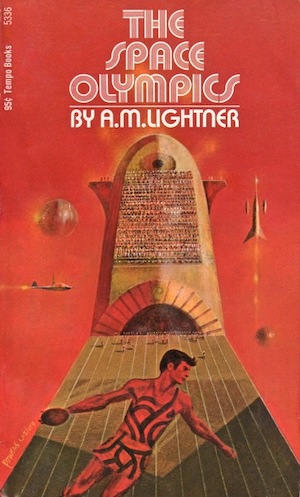
Arcadia’s first attempt to revive the ancient Olympics was a success. Now, three years later, the second Space Olympics are nigh. Would-be space empresario Barnum “Wink” Winkle is determined to field a team. Young Tyros Vann is just one of the athletes selected on the basis of skill and the fact that pure chance put them in Barnum’s path.
Arcadia celebrates the right of every off-world human athlete to compete in the Olympics. They bar aliens, even Arcadia’s natives, from competing. The Arcadians also frown on off-worlders winning. Can Tyros somehow overcome blatantly unfair rules-lawyering, or has the trip been a waste of time?
Barnum Winkle is more honest than the name might suggest. However, he is not very good at his current job. In his defense, these are only the second Space Olympics, so it’s not as if he had had the chance to obtain much experience with systematic talent searches… or to realize that the judges are wildly biased.
Urusei Yatsura by Rumiko Takahashi (1978-1989)

Ataru was born on an ill-fated day under unlucky stars. Ataru is lazy and impulsive. Ataru has a girlfriend, Shinobu, but the relationship seems doomed. How long will Shinobu will tolerate Ataru’s wandering eye and relentless womanizing1? He’s such a loser!
Too bad that Ataru is Earth’s champion in a high-stakes match.
The alien Oni could easily crush Earth’s military forces. Instead of a war, they propose a simple game of tag between champions: Ataru for Earth and the princess Lum for the Oni. Surely, even Ataru can win a game of tag! Unless, of course, Lum can cast lightning and fly…
In fact, Ataru’s complete lack of character allows him to win the race… with the unintended side effect of leaving Lum with the impression that he is now her fiancé, to the distress of Shinobu. Nor are Lum and Shinobu the only women to inexplicably fall for charmless Ataru. Readers that unfamiliar with the author, Takahashi, may be interested to learn Takahashi was a pioneer in the field of manga-and-anime-based Love Dodecahedrons.
The Devil’s Game by Poul Anderson (1980)
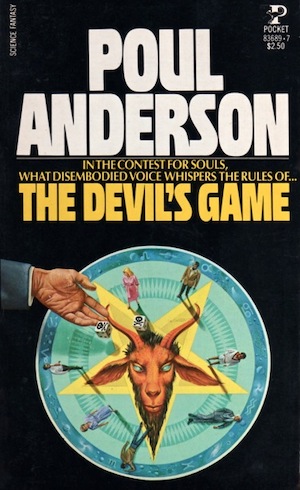
Thanks to the advice of his invisible, seemingly immaterial advisor Samael, Sunderland Haverner enjoyed a long life of wealth and luxury. There is a price to pay. Samael has a psychological experiment he would like Havener to conduct on Samael’s behalf.
The contestants gathered in Santa Ana are various—a hippie, a mobster, a revolutionary, an adventurer, a businessman, a would-be Good Samaritan, and a mother—but each has a pressing need for money. Havener’s offer of a million tax-free dollars is irresistible. Only one can win. Just how far are the contestants willing to go to claim the prize?
Readers may expect this to devolve almost immediately into murder and mayhem. It doesn’t, because the contestants for the most part share something beyond economic desperation. Most of them are able to empathize with each other’s plights.2
A Night in the Lonesome October by Roger Zelazny (1993)
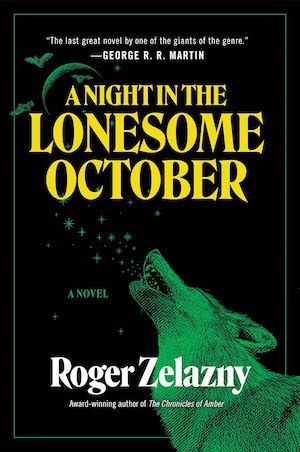
The Openers and the Closers have gathered to play a wonderful game. If the Openers win, the gates between worlds will be flung open. Entities of which it is best not to speak will pour into the mundane world, to the considerable (if short-lived) distress of humanity. If the Closers win, humanity will be spared, at least until the next time the stars are right.
The players are familiar icons: the Great Detective, the Russian monk, the world-famous vampire, a doctor known for bold efforts in reanimation, and of course, Jack, who is ever so clever with his knives. The contest will consume a full month. What merry hijinks will ensue…
There are lots of stories featuring Jack the Ripper as a character. In some, he is a protagonist. Lonesome October may be the only work in which Jack is a sympathetic protagonist. It helps tremendously that the viewpoint character is Jack’s faithful dog, Snuff.
Breath of the Dragon by Fonda Lee and Shannon Lee (2025)

Jun’s unsanctioned love of martial arts got Jun and his father exiled from revolutionary East Longham. Despite Jun’s father’s efforts to steer Jun towards more remunerative, less dangerous occupations, Jun has never stopped training and hoping for a chance to display his prowess.
Every six years, a new Guardian of the Scroll of Heaven is chosen via the Guardian’s Tournament. Jun is determined to take part in the next Tournament. Despite lacking supernatural gifts, he is determined to win. Jun might not be so determined if he understood the true price of victory.
It’s a tribute to human contrariness that despite the gods providing both the Scroll of Earth (which details natural science) and the Scroll of Heaven (which details proper governance), humans have still managed to muck things up. Still, the system seems to have worked well enough for thousands of years.
Science fiction and fantasy have featured many contests; the plot device might be nearly as popular as contrived court cases. No doubt I’ve overlooked many fine examples.3 Feel free to point out or recommend other competition-based stories in comments below.
- She’ll tolerate this for as long as it amuses the author. ↩︎
- Anderson had certain political-economic leanings, which get expressed in the course of the novel. Interestingly, the character selected to deliver these tirades is Havener, who is not at all sympathetic. One might even say antagonistic. ↩︎
- I am sure there was a science fiction sports comic, back in the 1960s. I do wish I could remember the title. ↩︎

The first of John Christopher’s Tripods novels has a combo beauty contest/athletic contest where the winners of the beauty contest get turned into displays like butterflies pinned to a board and the winners of the athletic contest get the honor of being worked to death by the Tripods.
Legion of Superhero try-outs probably count as a contest. Winners get to tackle with cosmic threats, losers get subjected to snide criticism. Still, “your powers are too weak/too poorly control/clearly are generated from that device you keep fiddling with/Inferno does not think you are attractive” may well be better than “You and four other team members whose defensive powers are far greater than yours will be dealing with the personification of entropy. Good luck with that!”
Consider that for most Legion members, their powers are simply natural racial abilities. Which leads me to wonder what the human power could be; I proposed long distance running. Never mind the Earth woman’s skill in martial arts, tactics and multiple sciences, the AMAZING thing is she can run 26.2 miles in four hours
The Player of Games features strategy games, not physical ones, but come on, it’s in the title!
I’d add Catherynne M. Valente’s Space Opera – a galactic take on the Eurovision song competition.
Re: footnote 3, could you be thinking of Strange Sports Stories? I feel like I read a collected digest-sized version of at least some of these in the 80s or early 90s.
Yep; “Strange Sports Stories” featured in several issues of DC’s “Brave and the Bold” in the mid ‘60s – though it never became a regular title at the time. It was edited by Julius Schwartz and written and drawn by the same creatives who worked on the Schwartz- edited “Strange Adventures “ and “Mystery in Space”, with art primarily (entirely?) by Carmine Infantino. Most of the contents were reprinted in the late ‘60s-early ‘70s in several issues of “DC Special” -and there may have been some later digest reprints as well. Pretty entertaining stuff.
The obvious one you’ve missed is Sheckley’s Seventh Victim, filmed as The Tenth Victim.
https://en.wikipedia.org/wiki/The_10th_Victim
It’s basically assassination as a sport. One of the inspirations for Steve Jackson Games’ Killer.
And don’t forget Death Race 2000!
Oops – I forgot Nigel Kneale’s Year of the Sex Olympics, which is basically a very dystopian take on Brave New World and The Machine Stops, and is often considered to have anticipated the sleazier side of reality TV.
https://en.wikipedia.org/wiki/The_Year_of_the_Sex_Olympics
How can we leave out PROSE BOWL, by Bill Pronzini & Barry Malzberg, where stadium-set contact sports like football have given way to pulp writers competing, with their words on giant screens for the stadium crowds to follow, to complete a story on a given theme and word limit within a certain time constraint.
The Hoka stories, by Poul Anderson and Gordon R. Dickson, include at least one sports story- Joy in Mudville.
https://en.wikipedia.org/wiki/Hoka!_Hoka!_Hoka!
The first thing that comes to my mind in this general area is the Olympics in Isaac Asimov’s Profession.
There’s a story about a junior basketball league, where a team of heavy worlder aliens is running away with the competition due to being able to outjump their competitors. The presence of the alien team was supposed to improve interspecies relations, but their overwhelming success turned out to be a problem because the xenophobic faction among the aliens will use this for propaganda purposes. The protagonist is desperately trying to find a strategy for the human team to win the final match (for plot purposes the two best teams didn’t meet until the end of the season), but the situation is resolved when the alien team throws the match in the second half – they belonged to the peace faction among the aliens, and when they became aware of the larger stakes took the position that winning the larger competition was more important.
I thought this was an early career George R.R. Martin story, but none of the title in his bibliography strikes a bell.
My second attempt at an author (Norman Spinrad) doesn’t find this story, but reminds me of The National Pastime (American football turned up to 11.)
Web searching was successful either, but reminded me of Arthur C. Clarke’s Sunjammer.
IT’s not what you are thinking of but the basketball team made me think of Space Jam.
I don’t think that I have ever met anyone else who has read “The Devil’s Game”. Or admitted to it. That book was boring.
I’ve read it. I thought it was reasonably interesting, but not enough to read it again.
I read it some years ago, but at this point all I remember is a lingering doubt as to whether there might be two authors named Poul Anderson.
I read it. It was indeed boring but I have read many worse books.
I read The Devil’s Game more or less back to back with Brunner’s Players at the Game of People. The two books came out about a month apart and share the detail of humans carrying out tasks for inhuman patrons whose motives are obscure.
Iain Banks’ Player of Games would seem to a good fit for this list. Gamer wind a game and gets to rule a world, except the locals object.
Shout out to A Night in the Lonesome October! Such a great read, especially in October.
Several folks have already recommend Iain M. Banks’ The Player of Games which is an excellent look at how a whole empire centers its choice of rule and power around a specific game. I recently read this on audio and I couldn’t help but wonder if it had been inspired in some small part by Piers Anthony’s Apprentice Adept series (which also has elements that fit this topic, but I really can’t recommend because, well… Anthony).
Kind of akin to this would be Scott Lynch’s third Locke Lamora book, The Republic of Thieves where the competition is a city’s election, but Lamora and Jean are arrayed against another “player” to rig and win the election for their patrons.
Claire North’s The Gameshouse creates a gaming place outside of the real world where people play all the usual games, but also get involved in games that have large scale consequences in the world.
Oh yeah, and then I remembered both The Long Walk (which will be getting a film release this fall) and The Running Man (which is also getting a new film release this fall), both by Stephen King that feature rather grisly competitions.
Don’t recall if it was one of the Retief series or not, but there’s a pretty entertaining short story that has been included in a few anthologies about a human junior diplomat/researcher who ends up having to face off against the local “champion” in a series of trials of strength that includes a “fight”; one thing that sticks in the non-human antagonist has a sponge-like quality that makes a difference in the “fight” … IIRC, it ends positively (non one ends up dead or wounded) and the humans and non-humans agree to peaceful relations…
Ring a bell?
The first Retief story published (but probably the last in internal chronology), “Diplomat-at-Arms,” involves Retief winning a tournament composed of a series of physical contests.
That sounds like a Scalzi, in his Old Man’s War series. I forget which story though.
After the Coup, I think.
It’s one of the early chapters in The Human Division.
I remember Achilles’ Choice, by Niven and Barnes. It was set in an Olympics setting with body modification. There was something about the modified eventually becoming powerful in the world because they were basically connected to the Net. I have to admit I don’t remember all that much, but it had a striking cover: https://www.goodreads.com/book/show/850597.Achilles_Choice
Is that the one where everyone does mods-or-drugs before the contest, and only the winners get the antidotes/balances, or am I thinking of another Niven-and? I would have sworn that was a Niven plot, but the details I remember don’t match yours.
That would be the one. The competitions included both physical and artistic competitions, but you really cannot win without the drugs, but the drugs kill, and only the winner gets the cure. I wanted to reread it a few years ago, but it’s no longer in print, not even as an ebook
Niven and Barnes also produced the Dream Park series, which were about gaming scenarios based upon augmented reality technology.
Do I have to mention Piers Anthony’s “Apprentice Adept” series, with their regular installments of The Game on Proton?
I suppose someone must.
Damn.
Nobody need mention that.
In Dave Duncan’s Ill-Met in the Arena the protagonist has to enter a number of tournaments where male aristocrats engage in contests of psychic powers.
Dungeon Crawler Carl series seems an obvious recent choice.
Since nobody else has, I’ll go ahead and bring up the obligatory (for me) Star Trek episodes (TOS only; someone else can deal with the other stuff):-
The Gameplayers of Zan: post human species use the game as cover for developing interplanetary spacecraft to escape Earth
In “Bullard Reflects” we’re shown a game of reflectors and a “light pistol” (the goals are photocells); the team’s skills turn out to have life-or-death uses.
In “Fiesta Brava”, the way to become president is to win a bullfighting contest. (This is one of Mack Reynolds’s Section G stories, in which, like John Barnes’s Thousand Cultures, humanity has colonized a great many planets with a great many … systems … of governance.)
There’s at least one other old short story that vanished from my mind while typing these, so I’ll leave you with Killerbowl, in which football is played on large parts of evacuated downtowns; the safety carries a one-shot pistol, which is just one of the justifications for the title. This is by Gary K. Wolf, who also gave us the much lighter novel that mutated into Who Framed Roger Rabbit?
Found it: psychic sumo in Howard Waldrop’s “Man-Mountain Gentian”.
And leaving athletics for a bit: a chess match underlies The Squares of the City.
Hussade features in most of Vance’s Alastor Cluster books, and is described in considerable detail in Trullion: Alastor 2262. Successful teams must combine speed, strength, skill, strategic thinking, and the ability to execute complex maneuvers.
In Arthur Byron Cover’s novelette “The Platypus of Doom”, the protagonist is chosen to champion his race against the Black Pirates in the game. The winner is awarded a visit by the eponymous monotreme, while the loser dies instantly. The Black Pirates never lose, and the game is widely viewed as a means for them to humiliate other races. Any resemblance between the game and table tennis is purely intentional.
Walter Jon Williams’ House of Shards memorably features “the race”, conducted in weightlessness through a complicated series of narrow chutes. Use of the arms and hands carries a time penalty or complete disqualification. Despite all the rules, contestants often inexplicably manage to injure one another.
And there’s William Harrison’s short story “Roller Ball Murder”, and the movie of the same name.
The terms of The Devil’s Game are not that only one can win. All of those who survive till the end will share the prize money equally.
“Sunjammer”, also published as “The Wind from the Sun” by Arthur Clarke was about a race between various solar sail spaceships.
Ann Leckie’s short story, She Commands Me And I Obey, is set in her Imperial Radch universe.
The leadership of the Itran Tetrarchy is decided by an Election Ballgame, with the losing captain being executed on the playing field by the winning captain.
Politics, religion, and commerce combine to create an unexpected result.
Gideon the Ninth
Also the recently published Raven Scholar
There was also Rules of Moopsball by Gary Cohn in Orbit 18.
Gary Cohn also wrote some stories for DCs Legion of Superheroes, and Moopsball was mentioned a number of times in the book’s run–it was the 30th (and later 31st) century’s major sport.